
What Is Entity SEO? How Google and AI Engines Recognize Your Business

In May 2012, Google explained a problem with a two-word search: [taj mahal]. To a search engine built on keyword matching, those were “just that—two words.” To a person, they could mean a monument, a Grammy-winning musician, a casino in Atlantic City, or the Indian restaurant down the street. Google’s fix was the Knowledge Graph, a model of “real-world entities and their relationships to one another,” which it summed up in four words: things, not strings.
That phrase is the shortest definition of entity SEO you’ll find. And it matters more now than it did in 2012, because AI answers often name businesses directly instead of handing people a page of links to sort through. Before an engine can name yours, it has to be sure which business you are.
Entity SEO, defined
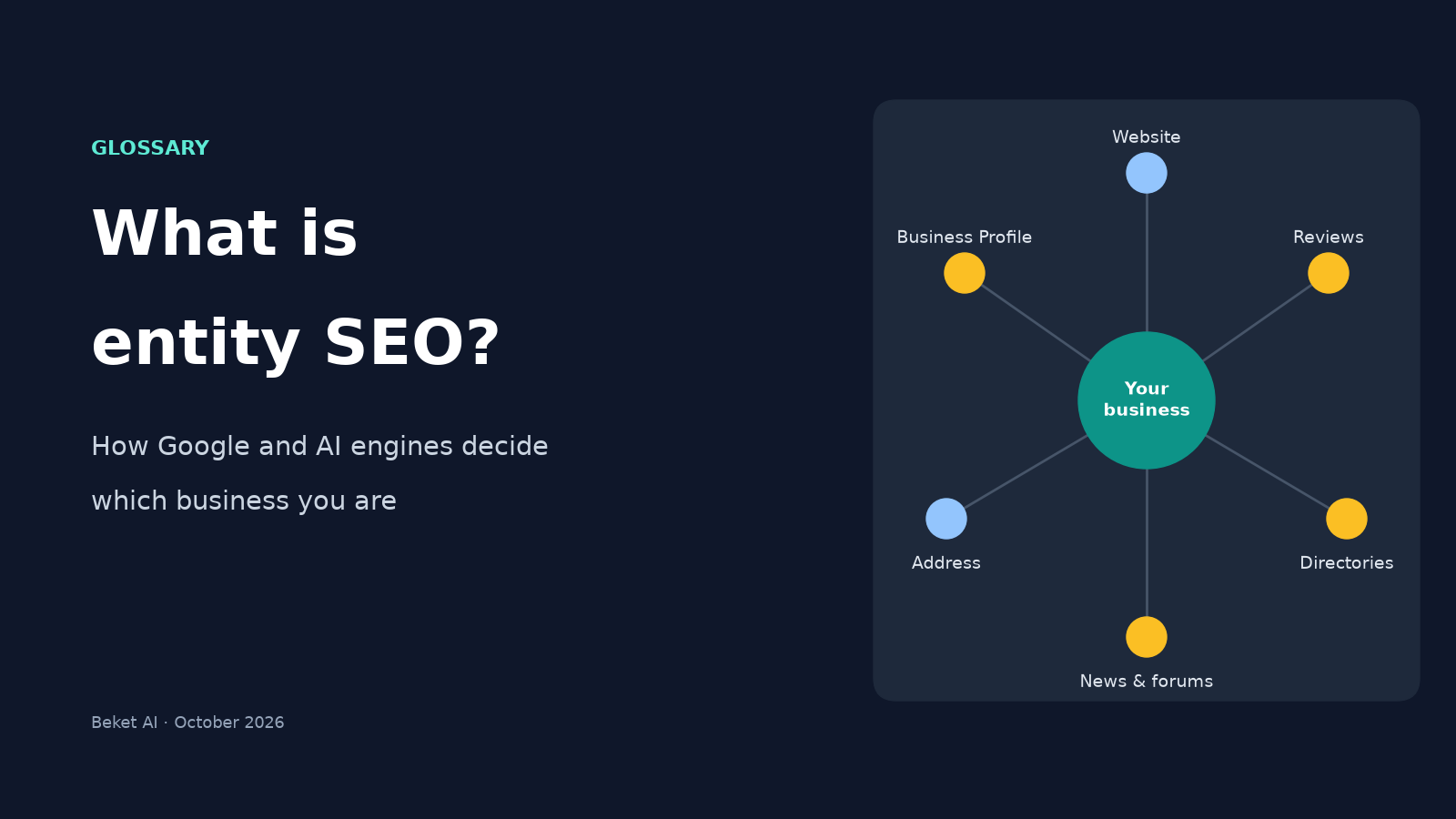
Entity SEO is the work of making a search engine or AI system confident about three things: that your business is one specific, real thing (an entity); what its facts are (name, location, category, services, owner); and how it connects to other things (the city it serves, the profiles and sites that talk about it).
Keyword SEO asks, “Which words should this page rank for?” Entity SEO asks, “When someone mentions us anywhere, does the machine know it’s us, and does it have our facts right?”
| Keyword SEO | Entity SEO | |
|---|---|---|
| Unit of work | A page and the words on it | The business itself, across the web |
| Main question | Does this page match the query? | Does the engine know who we are? |
| Where it happens | Mostly on your own site | Your site, Business Profile, directories, reviews, press |
| Typical failure | The page doesn’t rank | The engine mixes you up with someone else, or leaves you out |
| How you check it | Rank trackers, Search Console | Ask search and AI engines about your business and compare the answers to the facts |
The two aren’t rivals. A page still has to be crawlable, indexed, and useful. Entity SEO is the layer underneath that tells engines whose page it is.
What counts as an entity
An entity is anything that can be uniquely identified: a person, a place, an organization, a product, an event. Google’s Knowledge Graph Search API documentation lists the kinds of entities in its graph, and LocalBusiness and Organization sit on that list next to Person, Place, Event, and Movie. The API returns those entities using standard schema.org types, the same vocabulary you use in structured data on your site.
The graph has grown a lot. At launch, Google said it held more than 500 million objects and 3.5 billion facts. By 2020, in a post explaining knowledge panels, Google said it had “amassed over 500 billion facts about five billion entities.”
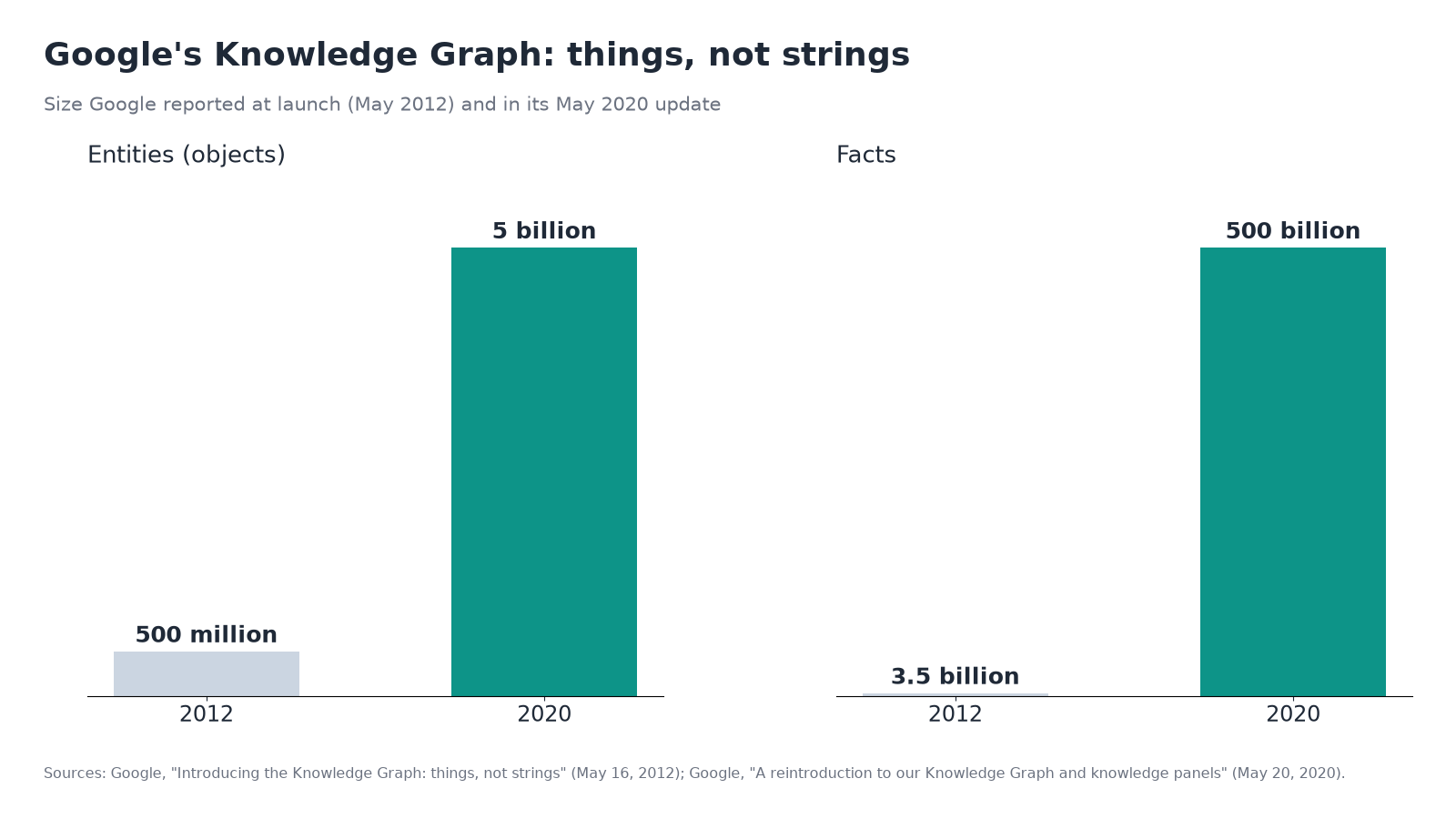
Both counts come from Google’s own posts. And as the type list above shows, the graph isn’t only for celebrities and landmarks; local businesses are one of its listed entity types.
Where an engine gets the facts about your business
You don’t fill in your entity record in one place. Engines build it from many sources and reconcile them, which is why consistency matters.
Google. The 2020 post says the Knowledge Graph draws on “materials shared across the web, as well as from open source and licensed databases,” with Wikipedia as one common source among “hundreds.” For local businesses, Google’s Business Profile help page on how Google sources business information lists four inputs:
- Publicly available information, such as crawled content from the business’s official website
- Licensed data from third parties
- Users who contribute facts, photos and reviews, including owners who claim their profile
- Information from Google’s own interactions with the place or business
ChatGPT. OpenAI’s help page on searching the web with ChatGPT says ChatGPT rewrites a question like “good restaurants near me” into a search query such as “top restaurants San Francisco,” using the person’s approximate location. It also says ChatGPT “may share your location with trusted third-party providers that help provide more local information, such as nearby business listings.” In other words, the business listings you have on other platforms can feed the answer, not just your website. (For the full path from question to citation, see our explainer on how ChatGPT search finds and cites websites.)
None of these sources is under your full control. That’s the core of entity SEO: you can’t type your facts into the engine, so you make sure every source it reads agrees.
Why entities matter more in AI answers
Google’s own guidance on AI features and your website is plain: there are “no additional requirements to appear in AI Overviews or AI Mode,” and no special schema to add. But two items on its list of SEO basics that still apply are entity work in all but name: “making sure your structured data matches the visible text on the page” and “checking that your Merchant Center and Business Profile information is up-to-date.”
The strongest outside evidence points the same way. Ahrefs looked at 75,000 brands and compared search factors with how often each brand was mentioned in AI Overviews. The top three signals were all about the brand’s name showing up elsewhere, not about links to its site:
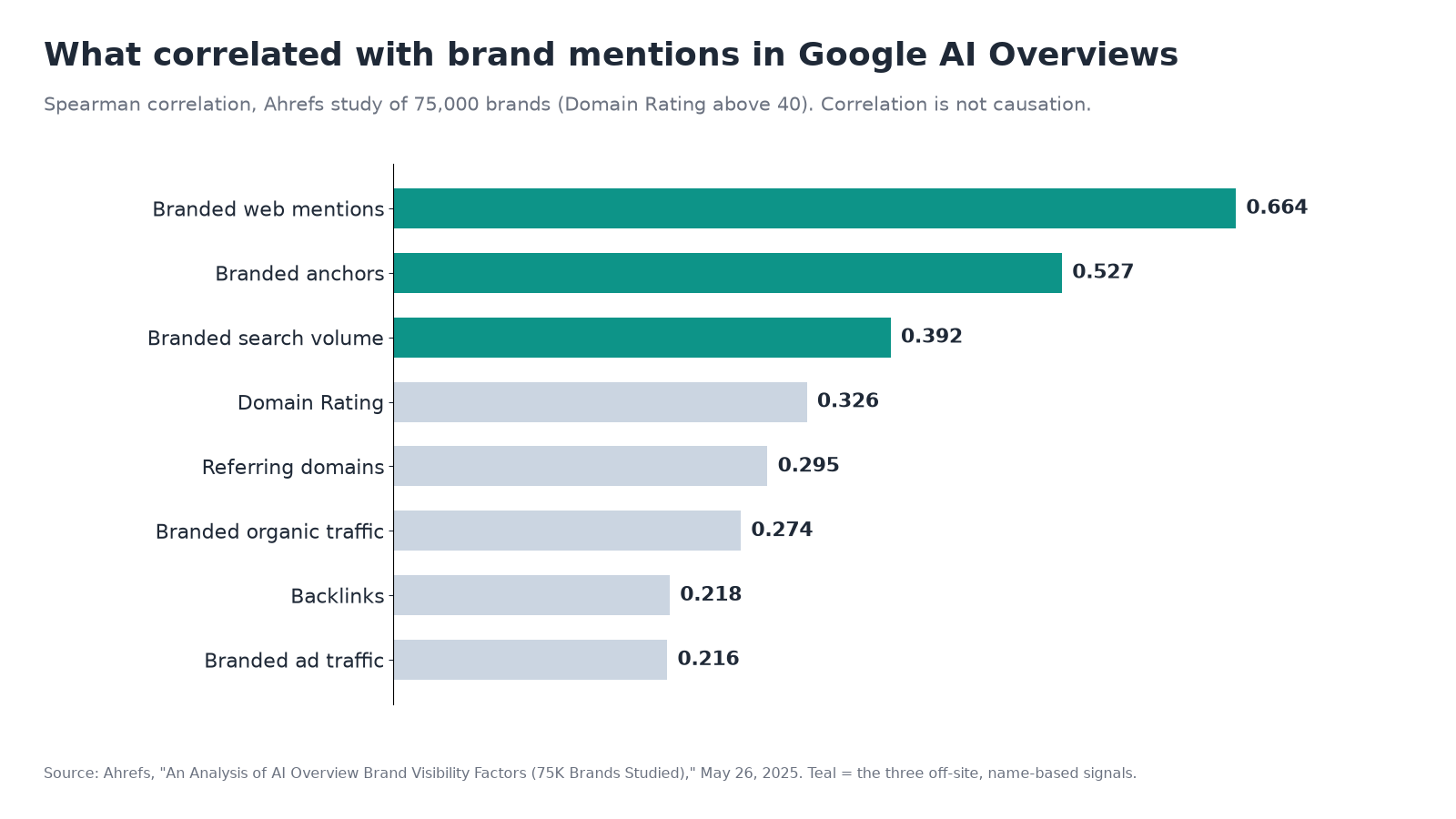
Two caveats keep this honest. It’s a correlation, which Ahrefs itself stresses is not causation. And the sample was brands with a Domain Rating above 40, plus real search demand for their top keyword, not small local businesses specifically. Still, the pattern fits how entities work: an engine that keeps meeting your name, in context, on pages it trusts, has more to go on. We’ve written more about that shift in why brand mentions are becoming the backlinks of AI search.
The flip side is the failure mode. When an engine isn’t sure which entity you are, it guesses, and sometimes it blends you with a business that has a similar name. We call that AI’s doppelganger problem.
The entity SEO glossary
Terms you’ll run into, in plain language:
- Entity: A uniquely identifiable thing, such as your business, its owner, or the city it serves.
- Attribute: A fact about an entity: address, phone number, opening hours, category, founding date.
- Knowledge Graph: Google’s database of entities and the relationships between them.
- Knowledge panel: The box of facts Google shows about an entity. Google says many panels can be claimed by their subject; local businesses manage theirs through Business Profile.
- Disambiguation: Telling two entities with similar names apart. Google says some Organization properties, like
naicsandiso6523Code, are “used behind the scenes to disambiguate your organization from other organizations.” - sameAs: A schema.org property for “a reference Web page that unambiguously indicates the item’s identity,” such as an official profile. Schema.org’s definition gives Wikipedia, Wikidata, and official websites as examples.
- Entity home: An informal SEO term for the one page on your site that describes the business best, usually the home or About page. Google recommends putting Organization markup on exactly that kind of page.
- Structured data: Code (usually JSON-LD) that restates your facts in schema.org vocabulary so machines don’t have to guess.
How to do entity SEO for a local business
You don’t need a Wikipedia page to do this well. Six steps cover most of it.
- Pick one name and use it everywhere. The same spelling on your sign, website, Business Profile, invoices, and directory listings. If you rebranded, update the old listings rather than leaving both names live.
- Make one page the source of truth. Your home or About page should say, in text, who you are, what you do, where you are, and how to reach you. Google’s Organization structured data guide recommends placing that markup on “your home page, or a single page that describes your organization,” and using the most specific
LocalBusinesssubtype if you serve customers locally. - Add structured data that matches the page. Name, address, phone, URL, logo, and
sameAslinks to your real profiles. Google says theurlproperty “helps Google uniquely identify your organization.” Our local business schema markup guide walks through the code and testing. - Verify and complete your Business Profile. Google’s page on improving local ranking says businesses “with complete and accurate info are more likely to show up in local search results,” and names relevance, distance, and prominence (which it also calls popularity) as the main factors.
- Earn mentions where your customers already look. Local press, industry associations, review sites, community forums. Each one that names you correctly is another source agreeing on who you are.
- Check what the engines actually say. Ask ChatGPT, Gemini, and Perplexity what they know about your business and who they’d recommend in your category and city. Compare every fact against reality. Wrong hours, an old address, or a competitor’s details in your answer all point back to a source that needs fixing.
What entity SEO won’t do
It won’t guarantee a knowledge panel, a rich result, or a mention in an AI answer. Google says plainly that it “does not guarantee that features that consume structured data will show up in search results,” and that indexing and serving aren’t guaranteed for AI features either. Entity work doesn’t replace useful pages, reviews, or a good reputation. What it does is remove the reasons an engine might hesitate to name you: conflicting facts, a name it can’t place, or a business it confuses with someone else.
See how AI engines describe your business
Step 6 is the one most businesses skip, because asking three engines dozens of questions by hand gets old fast. Beket AI’s free audit runs 25 prompts across 3 AI engines and shows whether each one names your business and how it describes you. Beket AI Pro is $49/month, starts at 50 prompts across the same 3 engines, and re-audits daily, so you can see whether a fixed listing or a new mention changes what the engines say.
Related posts
Which Vancouver Realtors Does AI Recommend? 2026 Study
Oakwyn Realty led 237 AI mentions of Vancouver realtors on October 23, 2026. See who ChatGPT, Perplexity and Google AI Overview named, and how.
How to Show Up in Google AI Overviews: 7 Steps for Local Businesses
Google says AI Overviews need no special tricks. Here are 7 practical steps, with study data, to get your business pages cited, plus a checklist.
Which Vancouver Mortgage Brokers Does AI Name? 2026 Study
Pinsky Mortgages led 236 AI mentions of Vancouver mortgage brokers on October 23, 2026. See who ChatGPT, Perplexity and Google AI Overview named, and how.