
The Complete Playbook for AI Search Optimization (GEO & AEO)
How AI search engines choose sources, how SEO, AEO and GEO fit together, and a 7-step framework for content, crawlers, earned media and measuring AI citations.

On this page
AI search changes what it means to be found online. This playbook covers how answer engines pick their sources, how traditional SEO, AEO and GEO fit together, and a step-by-step framework for content, technical setup, earned media and measurement.
1. The paradigm shift: from blue links to generative answers
Digital discovery is going through a structural change. For more than two decades, search engine optimization (SEO) meant winning top placements on traditional search engine results pages (SERPs): competing for rankings across ten blue links. Today, discovery is moving toward direct, AI-synthesized answers from answer engines and large language models (LLMs). Instead of clicking through to web pages, people using Google, ChatGPT, Perplexity, Gemini and Copilot get a complete, real-time synthesized response.
For anyone responsible for search strategy, visibility is no longer defined by URL rank alone. You need to become the cited, authoritative passage that informs the model’s answer. Because AI search is non-linear and passage-based, durable brand visibility depends on three things working together: technical accessibility, extractable formatting, and off-site consensus.
Market data synthesis
The numbers behind this shift:
- Zero-click searches are now the majority. About 68% of US Google searches ended without a click to the open web in January–April 2026, according to SparkToro’s analysis of Similarweb clickstream data. In a Pew Research Center study of 68,879 real searches by 900 US adults, users ended their browsing session after 26% of visits to a page with an AI summary, compared with 16% of visits to a page without one.
- AI Overviews pull clicks away from traditional results. In the same Pew study, users clicked a traditional result on 8% of visits when an AI summary appeared, versus 15% when it didn’t, and clicked a link inside the AI summary itself on just 1% of visits. Ahrefs found that the presence of an AI Overview correlated with a 58% lower average click-through rate for the top-ranking page (December 2025 data). A randomized field experiment by Agarwal and Sen, with 1,065 US desktop Chrome users, found that AI Overviews cut organic clicks on queries that triggered them by about 38%.
- AI search runs at massive scale. Google said at I/O 2026 that AI Overviews reach more than 2.5 billion monthly users and AI Mode has passed 1 billion. AI Overviews have been available in more than 200 countries and territories since May 2025, and the average AI Mode query in the US is three times as long as a traditional search query.
- AI referral traffic is small but growing fast. Across 2.3 billion sessions analyzed by WebFX, sessions referred by generative AI platforms grew 796% year over year, and conversions from those sessions grew 6,432%. AI referrals were still only 0.18% of all sessions in that data set, so the growth is starting from a small base.
Industry lead generation impact
The move toward generative answers changes how buyers in every vertical discover and choose vendors:
- Construction companies. Traditional SEO focuses on ranking a general contractor on Google for regional terms like “commercial construction company Des Moines.” In an AI-first world, discovery expands to generative engine optimization (GEO) and answer engine optimization (AEO). When a commercial property developer asks ChatGPT for experienced commercial builders in Iowa, or a homeowner asks Google “how do I find a reliable contractor for a home addition,” being named in the answer drives quote requests, consultation calls and contract opportunities.
- Healthcare providers. Patients research symptoms, treatments and provider credentials before they book. Practices that publish well-structured, factual answers to clinical questions build trust before the appointment. Being selected as a source in AI-generated health summaries increases local visibility and online bookings.
- Home service businesses. For urgent, high-intent needs, like a burst pipe at 11 PM, people rarely compare multiple web pages. They want an immediate answer from a voice assistant (Siri, Alexa, Google Assistant), a local AI search or an AI Overview. Businesses whose content is easy to extract as a direct answer reach ready-to-book customers at the exact moment of need.
- Manufacturers and B2B companies. B2B purchases involve long evaluations with many stakeholders. Decision-makers use AI tools to build product comparison tables, check compliance capabilities and research vendor reputation long before they fill in a contact form. Here, AI search operates inside the B2B “dark funnel.” When an AI engine names a manufacturer as a category leader, it builds early credibility across the whole buying committee and can speed up the pipeline before sales ever gets involved.
These shifts lead directly to the need for precise definitions of SEO, AEO and GEO.
2. Traditional SEO vs AEO vs GEO
Treating search engine optimization (SEO), answer engine optimization (AEO) and generative engine optimization (GEO) as separate silos is a strategic mistake. Modern search visibility doesn’t mean abandoning traditional SEO. It means extending it into a three-tier framework where each discipline reinforces the next.
3-way comparison matrix
| Parameter | Traditional SEO | Answer engine optimization (AEO) | Generative engine optimization (GEO) |
|---|---|---|---|
| Core focus | Rank individual pages in search results to drive organic clicks | Position content as the direct answer in featured snippets, voice search and Q&A modules | Get brand facts, entities and passages cited and recommended in LLM-synthesized answers |
| Target platforms | Traditional search engines (Google, Bing) | Google AI Overviews, Knowledge Graph, voice assistants (Siri, Alexa), featured snippets | ChatGPT Search, Perplexity, Google Gemini, Microsoft Copilot |
| Unit of optimization | Whole pages, meta tags and keyword clusters | Extractable answer blocks, direct definitions, FAQs and Q&A pairs | Text chunks, passages, data points, entity statements and earned coverage |
| Typical queries | Short keyword queries (1–3 words, informational or navigational) | Conversational questions, voice queries and long-tail “how / what / why” prompts | Complex research prompts, comparisons (“best X for Y”) and multi-part synthesis requests |
| Discovery and retrieval | Crawling and indexing, link equity (backlinks), on-page relevance and technical health | Structured data parsing (Schema.org), direct passage extraction and intent matching | Two paths: model memory (parametric recall) plus real-time web retrieval (RAG), entity extraction and passage scoring |
| Key success metrics | Keyword rankings, organic sessions, click-through rate (CTR) and page-level conversions | Featured snippet ownership, voice search share, Brand Mention Rate (BMR) and AI Overview impressions | Citation share, share of voice, Brand Mention Rate (BMR) and AI referral conversions |
The “mention-source divide”
There is a real disconnect between ranking organically and being picked as an AI source. A high Google ranking no longer guarantees that an answer engine will select your page.
Studies disagree on the exact overlap, but all of them find that a large share of AI Overview citations come from pages outside the organic top 10. BrightEdge found that only about 17% of sources cited in AI Overviews also ranked in the top 10 for the same query (February 2026). Ahrefs measured about 38% in a March 2026 study, down from 76% in its July 2025 analysis. Either way, most cited pages (roughly 62% to 83%) don’t rank on page one.
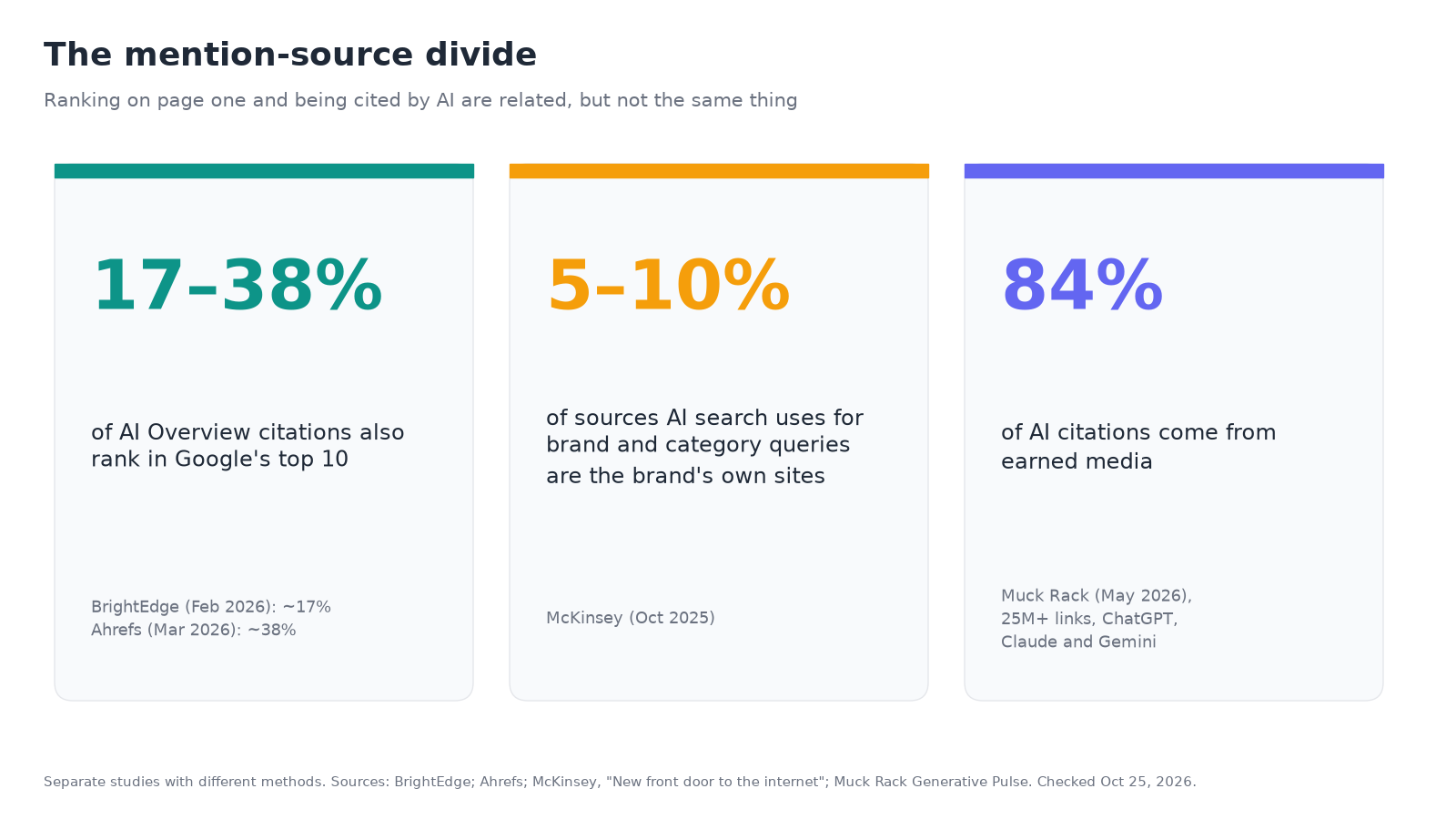
Your own website is also a small part of the picture. McKinsey’s analysis found that a brand’s own sites typically make up only 5% to 10% of the sources AI search references for queries about that brand or its category. The rest come from third-party publishers, reviews, user forums and other external sources. In practice, AI models judge a brand by what the rest of the web says about it, not only by what the brand says about itself.
Closing that gap starts with understanding how AI engines discover, read and cite information.
3. How AI discovery works: the 6-stage answer pipeline
To engineer content for selection, you need to understand the basics of retrieval-augmented generation (RAG) and how LLMs process queries. Generative search engines don’t read a page as one monolithic document. Each engine works differently, but most follow a similar sequence: they retrieve, break pages into passages, score them and synthesize an answer. We walked through one engine end to end in how ChatGPT search works.
The 6-stage selection pipeline
| Stage | What happens | What it means for your content |
|---|---|---|
| 1. Query fan-out | The engine breaks one complex prompt into several narrower sub-queries to cover different parts of the intent. For example, “What is the best enterprise CMS for security?” can become separate searches for CMS security benchmarks, headless platform compliance standards and vulnerability reports. | Cover the sub-questions around a topic, not just the head term |
| 2. Retrieval | The system runs searches for each sub-query against a web index, using a search partner’s results, its own crawler and index, or both, and collects candidate URLs. | Your pages must be crawlable and indexed by the engines’ search crawlers |
| 3. Read and chunk | The engine fetches the candidate pages. Many AI crawlers don’t run JavaScript, so content that only appears after scripts load can be missed. The main text is split into smaller passages (“chunks”). | Put core content in the raw HTML, in self-contained passages |
| 4. Rank and re-rank | Passages are filtered and scored for relevance, factual density and source authority, and vague passages drop out. Selecting a small set of strong passages also helps with LLMs’ known “lost in the middle” weakness, where information in the middle of a long context is used less reliably than information at the start or end. | Make every passage specific and evidence-backed |
| 5. Synthesize | The LLM reads the top-scoring passages in its context window and writes a natural-language answer to the prompt. | Clear, quotable statements are easier to reuse accurately |
| 6. Cite | The engine matches claims in the answer back to source passages and adds inline citations linking to those URLs. | Cited passages are where your traffic and credibility come from |
Two retrieval paths: model memory vs live search
AI search engines draw on two distinct information sources when they answer:
| Road 1: model memory (parametric) | Road 2: live search (RAG) | |
|---|---|---|
| Where the information comes from | Training data stored in the model’s weights | Pages retrieved from the web at answer time |
| Freshness | Static and historical; changes only when the model is retrained | Current; reflects what’s live on the web |
| Citations | No inline citations | Inline links to source URLs |
| What you control | Long-term presence in widely used sources (Wikipedia, major media, well-known publications) | Crawlability, indexability and clean passage layout |
- Road 1 (model memory). This is information the model absorbed during pre-training and fine-tuning. It’s static, expensive to update and doesn’t come with inline web citations. Brands that are well represented in training data, such as Wikipedia and major media, get a baseline of awareness here, but can’t update facts quickly or earn citation links through this path.
- Road 2 (live search). When a prompt needs current information or web grounding, the engine searches the web, retrieves live passages and builds the answer from them. This path depends on crawlability, indexability and clean passage layout, and it’s the path that produces inline URL citations.
Moving from how indexing works to execution requires a blueprint that optimizes your assets for both paths.
4. The 7-step G.E.O.D.A.T.A. execution framework
The G.E.O.D.A.T.A. framework is an end-to-end roadmap for teams that want to grow AI search visibility, passage citations and referral conversions.
| Letter | Step | Core action |
|---|---|---|
| G | Groundwork and technical accessibility | Make every important page crawlable and readable without JavaScript |
| E | Extractable answer engineering | Lead with direct, self-contained answers |
| O | Entity-first topical coverage | Cover the whole topic, with clear E-E-A-T signals |
| D | Data and fact enrichment | Add sourced statistics, dates and expert quotes |
| A | Authority and third-party earned media | Earn mentions in independent publications and communities |
| T | Tool protocol and MCP optimization | Describe your tools clearly for AI agents |
| A | Analytics and citation ROI tracking | Measure presence, quality and impact |
G: Groundwork and technical accessibility
Make sure pages render fully for AI crawlers that don’t execute JavaScript. Use server-side rendering (SSR) or pre-rendering so the full body text is in the raw HTML. Make sure candidate pages return clean HTTP 200 status codes, respond quickly and consistently, and are explicitly allowed in robots.txt for the major search crawlers.
E: Extractable answer engineering
Format on-page text into discrete, modular passages using a bottom line up front (BLUF) approach. As a rule of thumb, place a concise, direct answer of about 40–60 words directly beneath the relevant H2 heading, and keep your key answers in the top part of the page so they’re easy to extract during the read-and-chunk stage.
O: Entity-first topical coverage
Move from isolated keyword targeting to complete entity coverage. Build pillar-and-cluster content hubs that cover core concepts, subtopics, edge cases and industry terminology. Add clear Experience, Expertise, Authoritativeness and Trustworthiness (E-E-A-T) signals: named author bios, credentials, a clear editorial policy and visible “last updated” dates.
D: Data and fact enrichment
Add verifiable numbers, statistics, dates and primary sources throughout your copy. In the GEO research paper from Princeton and IIT Delhi researchers, adding quotations, statistics and source citations to content were among the strongest ways to increase how visible it was in generative engine responses (details in section 5).
A: Authority and third-party earned media
Run off-site digital PR and brand mention campaigns. Because 84% of AI citations come from earned media rather than paid or brand-owned content, getting included in independent industry reviews, listicles, trade publications and community discussions (for example Reddit and YouTube) is essential for AI verification.
T: Tool protocol and MCP optimization
Prepare your infrastructure for AI agents by making your tools machine-readable. Write tool metadata, parameters and natural-language descriptions following Model Context Protocol (MCP) conventions so agents can understand and use your tools without ambiguity.
Example of tool description optimization:
WEAK MCP TOOL DESCRIPTION
"description": "Calculates commercial roof replacement estimates for buildings."

OPTIMIZED MCP TOOL DESCRIPTION (clear context, constraints and invocation rules)
"description": "Calculates commercial roof replacement cost estimates in USD for flat and
low-slope industrial buildings. Takes building square footage, membrane material type
(TPO, EPDM, PVC) and geographic ZIP code as inputs. Returns itemized material, labor and
teardown cost estimates. Use this tool whenever a user asks for commercial roofing cost
calculations or contractor estimate comparisons."
A: Analytics and citation ROI tracking
Set up tracking across all three layers of AEO measurement. Monitor Brand Mention Rate (BMR), citation share against named competitors, Google Search Console impression trends for AI Overviews and AI Mode, and GA4 custom channel segments for AI referral conversions.
This blueprint leads directly into the content formatting rules behind step “E” (extractable answer engineering).
5. Content formatting and structure
AI engines evaluate, score and lift individual passages rather than whole documents. That makes on-page layout and passage formatting central to generative engine optimization.
The “extractable block” content template
To make passages easy for AI systems to select, structure informational pages around this six-part template:
| # | Block | What it contains |
|---|---|---|
| 1 | BLUF / executive answer | 2–3 sentences (about 40–60 words) placed directly beneath the H2, answering the heading’s question on its own |
| 2 | Key takeaways | 3–5 bullet points summarizing the core insights, easy to ingest during chunking |
| 3 | Structured process | Numbered, sequential steps for operational and how-to queries |
| 4 | Edge cases and constraints | Explicit conditional statements (“If X applies, do Y; if Z applies, limit it to W”) that remove ambiguity and reduce the risk of the model getting it wrong |
| 5 | Concrete examples | 1–2 short, data-backed mini case studies or data points showing the idea in practice |
| 6 | Primary references | Outbound links to primary research, industry benchmarks or official documentation |
What the research says about GEO tactics
The original GEO paper, by researchers at Princeton and IIT Delhi and presented at KDD 2024, tested how specific content changes affect visibility in generative engine answers across a benchmark of 10,000 queries. The authors report that the best methods improved visibility by up to 40%.
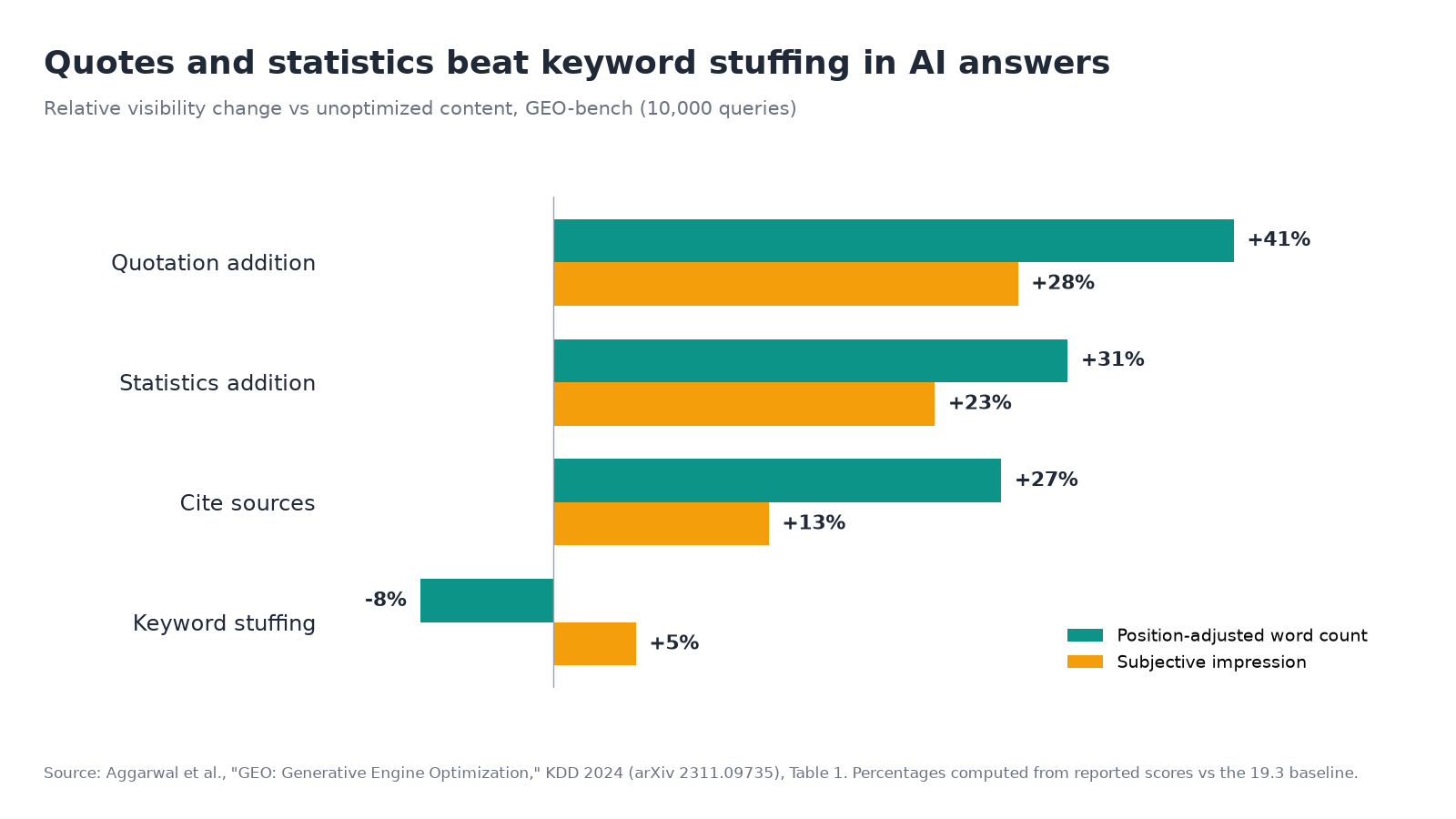
- Quotation addition was the top performer: adding credited quotes from relevant sources improved visibility by about 41% on the position-adjusted word count metric and about 28% on the subjective impression metric, compared with unoptimized content.
- Statistics addition came close behind: adding precise numbers, findings and percentages improved position-adjusted word count by about 31% and subjective impression by about 23%.
- Citing sources also helped (about 27% and 13%), while keyword stuffing, a classic SEO tactic, performed worse than doing nothing on position-adjusted word count.
Content format preferences. Answer engines also cite some page types more than others. In a Wix Studio AI Search Lab study of more than 1 million citations across ChatGPT, Google AI Mode and Perplexity, the most cited formats were:
| Content format | Share of citations |
|---|---|
| Listicles and comparison guides | 21.9% |
| In-depth informational articles | 16.7% |
| Product pages | 13.7% |
The first-screen rule
Where you put information on the page matters. In CXL’s analysis of AI Overview citations, 55% of the cited passages came from the top 30% of the source page. It was a small sample (100 citations), but it matches what the pipeline above would predict.
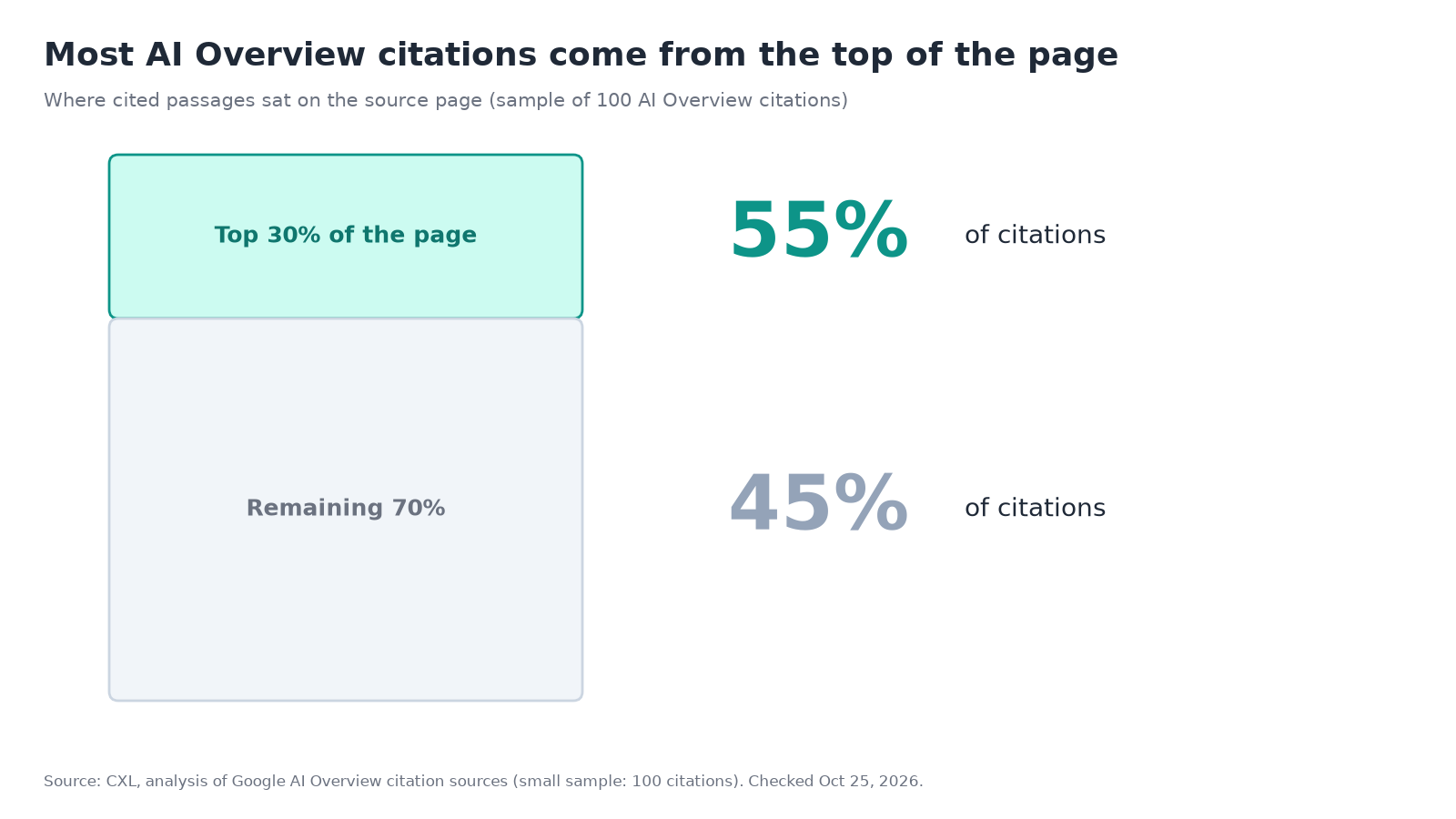
When direct answers, definitions or summary tables sit deep in long pages, inside client-side accordions or behind heavy JavaScript, they’re less likely to be extracted and cited.
On-page formatting only works if your server and site setup let AI crawlers discover, parse and validate the HTML underneath it.
6. Technical infrastructure: crawlers, protocols and schema markup
Making sure AI search crawlers can access and parse your content without friction is a prerequisite for AI search visibility.
AI crawler management matrix
Configure robots.txt to manage access for each AI user agent, and separate search crawlers from training crawlers. Note that Perplexity says Perplexity-User “generally ignores robots.txt rules”, because it fetches pages on demand when a user asks. Our guide to AI crawlers in robots.txt: training vs search bots covers every major bot in detail.
# Search crawlers (allow for AI search and AI Overview visibility)

User-agent: OAI-SearchBot
Allow: /

User-agent: PerplexityBot
Allow: /

User-agent: Perplexity-User
Allow: /

# Googlebot vs Google-Extended (search indexing vs Gemini training)

User-agent: Googlebot
Allow: /

User-agent: Google-Extended
Disallow: /

# Model training crawlers (disallow to limit training use without hurting search visibility)

User-agent: GPTBot
Disallow: /

User-agent: CCBot
Disallow: /
| Bot user agent | Operator | Primary purpose | Recommendation |
|---|---|---|---|
| OAI-SearchBot | OpenAI | Surfacing sites in ChatGPT search | Allow. Blocking it keeps you out of ChatGPT search answers and citations. |
| GPTBot | OpenAI | Crawling for model training | Disallow to limit training use; allow if you want more presence in future model memory. |
| PerplexityBot | Perplexity | Indexing and retrieval for Perplexity search | Allow. Also make sure your firewall (WAF) allows Perplexity’s published IP ranges. |
| Perplexity-User | Perplexity | On-demand fetches triggered by user actions | Allow. Perplexity says it generally ignores robots.txt because the fetch is user-initiated. |
| Googlebot | Web indexing for Google Search | Allow. Required for organic rankings and for AI Overviews and AI Mode. | |
| Google-Extended | A control token for Gemini model training and grounding, not a separate crawler | Disallow if you don’t want content used for Gemini training. Google says it doesn’t affect inclusion or ranking in Google Search, so AI Overviews aren’t affected. | |
| CCBot | Common Crawl | Building the open Common Crawl dataset, which is widely used to train models | Disallow to limit training use. |
Emerging machine-readable files
Beyond robots.txt, some sites add Markdown and JSON files at the root to give AI systems a curated view of the site:
root/
├── robots.txt       # Crawler permissions
├── sitemap.xml      # Traditional URL discovery index
├── llms.txt         # Lightweight Markdown index for LLMs
├── llms-full.txt    # Full-text version for direct ingestion
└── agents.json      # Agent capabilities and endpoints (emerging, illustrative)
These files aren’t equal, and none of them is a ranking shortcut. llms.txt is a proposal, not a standard, and Google says Google Search doesn’t use it. It’s most useful for AI agents and coding assistants reading documentation. We compared all three file types in llms.txt vs robots.txt vs schema markup.
- llms.txt setup. A Markdown file at
example.com/llms.txtthat gives a short, structured index of your site: what it is, its key sections and direct links to the most important pages, so an AI agent can follow the site structure without parsing HTML.
# Enterprise Cloud Security Platform

> Lightweight LLM directory for site architecture and core security documentation.

## Core Documentation

- [Zero Trust Architecture Overview](https://example.com/docs/zero-trust): Comprehensive guide to perimeterless security protocols.
- [API Security Benchmarks](https://example.com/docs/api-security): Performance and compliance benchmarks for REST/GraphQL APIs.

## Key Technical Specifications

- [SOC2 Type II Compliance](https://example.com/compliance/soc2): Audit reports and control implementations.
- [Model Context Protocol (MCP) Tools](https://example.com/mcp-tools): OpenAPI specs for security agents.
- llms-full.txt setup. An expanded Markdown file at
example.com/llms-full.txtcontaining the full plain-text documentation, so an agent can read it in a single pass. - agents.json. There’s no single agreed standard for this file yet, and AI search engines haven’t said they read it. The example below is illustrative: a machine-readable description of what agents may do and which endpoints they can call.
{
  "agent_protocol_version": "1.0",
  "organization": "Enterprise Security Systems",
  "contact": "security@example.com",
  "allowed_agents": ["OAI-SearchBot", "PerplexityBot"],
  "endpoints": [
    {
      "name": "AuditCheck",
      "path": "/api/v1/audit-check",
      "description": "Verifies vendor SOC2 compliance status."
    }
  ]
}
Structured data realities
Adding Schema.org JSON-LD markup, such as Organization, Article, FAQPage, HowTo and Speakable, is standard technical practice. Structured data helps machines identify entities, author relationships and product details without ambiguity.
But it has limits. When Ahrefs compared 1,885 pages that added JSON-LD schema with 4,000 similar pages that didn’t, adding schema made no meaningful difference to AI citation rates.
Schema is still worth having for entity identification, machine parsing and knowledge graph signals, but it isn’t a citation shortcut. AI engines select content based on passage-level relevance, factual density and third-party authority, not on the presence of markup alone.
Technical crawlability gets you into the index. Real AI visibility is driven mostly by off-site earned authority.
7. The earned media engine: off-site authority
AI answers lean heavily on independent, third-party sources rather than on what brands say about themselves. That gives off-site mentions and third-party editorial coverage far more influence over AI brand recommendations than self-published website copy.
The 84% earned media imperative
Third-party media dominates AI citations:
| Source type | Finding | Source |
|---|---|---|
| Earned media | 84% of AI citations | Muck Rack, May 2026 (25M+ links cited by ChatGPT, Claude and Gemini) |
| Paid / advertorial | 0.3% of AI citations | Same Muck Rack study |
| Brand-owned sites | 5–10% of sources for brand and category queries | McKinsey (a separate analysis) |
- 84% of AI citations come from earned media. Muck Rack’s definition includes independent journalism, academic and government sources, encyclopedic sources and third-party company content.
- Paid placements and sponsored content make up just 0.3% of citations in the same study.
- Brand mentions correlate more strongly than backlinks. In an Ahrefs study of 75,000 brands, web mentions of a brand correlated about three times more strongly with AI Overview visibility than backlinks did (0.664 vs 0.218). That’s a correlation, not proof of cause, but it points in the same direction as the citation data.
- Distribution increases citations. Stacker’s research on stories distributed across its publisher network found a median 239% lift in AI visibility across 87 stories, after an earlier eight-story study showed 325%. Stacker sells that distribution, so treat the size of the lift with some caution.
Multi-platform citation multipliers
PR and communications teams should go beyond traditional link building and build authority on the platforms AI engines use heavily:
| Channel | What to build | Why it matters |
|---|---|---|
| YouTube | Video transcripts and detailed descriptions | One of the three most cited sources in Google’s AI summaries, per Pew |
| Reddit and forums | Genuine peer discussions and real-world proof | Reddit is also among the three most cited sources in Google’s AI summaries |
| Wikipedia and Wikidata | Accurate, well-sourced entity entries | Canonical entity data that feeds knowledge graphs and model training |
| Digital PR and listicles | Placement in third-party roundups and comparisons | Listicles are the most cited content format in the Wix study |
- YouTube. In Pew’s study, Wikipedia, YouTube and Reddit were the sources most often linked in Google’s AI summaries, together making up 15% of all sources listed. Publish videos with accurate transcripts and detailed descriptions so the content is readable as text.
- Reddit and community forums. AI engines draw on authentic user discussions, peer reviews and technical threads to gauge brand sentiment and community consensus.
- Wikipedia and Wikidata. Accurate, verifiable entries on Wikidata and, where you genuinely meet the notability guidelines, Wikipedia create canonical knowledge graph entries that reinforce brand recognition in model memory.
- Digital PR and industry listicles. Getting included in third-party roundups (for example, “top enterprise cloud security tools”) feeds directly into the listicle format that answer engines cite most.
Once your earned media engine is running, the final step is measuring its ROI and pipeline impact.
8. Measuring AI search performance and citation ROI
Traditional analytics platforms such as GA4 and Google Search Console were built for a link-click model. They miss zero-click AI impressions, mentions that come from model memory and unlinked conversational mentions. You need a dedicated three-layer AEO measurement framework to quantify performance.
The 3-layer measurement system
| Layer | What it measures | Key metrics |
|---|---|---|
| 1. Citation presence | Whether your brand appears for target prompts | Brand Mention Rate (BMR), citation share, query coverage |
| 2. Citation quality | How accurately and favorably you’re described | Accuracy rate, differentiator inclusion, competitive positioning |
| 3. Citation impact | What it does for traffic and pipeline | GA4 AI channel traffic, Search Console AI impressions, dark funnel pipeline |
Layer 1: Citation presence
Tracks whether your brand shows up across your target commercial prompts.
- Brand Mention Rate (BMR): the percentage of target AI responses that mention your brand. This is the primary AEO health metric.
- Citation share: your brand’s mentions as a percentage of all brand mentions (yours plus competitors’) across a prompt set.
- Query coverage: the percentage of target commercial queries that return at least one citation pointing to a URL you own.
Layer 2: Citation quality
Evaluates the framing, accuracy and sentiment of the answers.
- Accuracy rate: the percentage of brand mentions that correctly describe your current products, pricing and services, without hallucinations or outdated facts.
- Differentiator mention rate: how consistently AI answers mention your key value propositions, such as specific compliance certifications or proprietary technology.
- Competitive positioning: whether you’re framed as the category leader, a primary option or a budget alternative compared with the competitors listed.
Layer 3: Citation impact
Quantifies commercial outcomes across trackable and hard-to-track channels.
Analytics and tool stack setup
Set up explicit tracking across your analytics stack:
- GA4 AI assistant channel. Create a custom channel group in GA4 that isolates AI referral traffic using a regex on the session source, covering referrals from chatgpt.com, perplexity.ai, claude.ai, copilot.microsoft.com and gemini.google.com. ChatGPT also adds
utm_source=chatgpt.comto many outbound links.
.*(chatgpt\.com|perplexity\.ai|claude\.ai|copilot\.microsoft\.com|gemini\.google\.com).*
AI referral volume is small, but it can be valuable. Across WebFX’s data set, AI-referred visitors converted at about 1.2 times the rate of organic search visitors. Results vary widely by site: Ahrefs reported that on its own website, AI search visitors made up 0.5% of traffic but drove 12.1% of signups, converting at 23 times the rate of traditional organic visitors. Measure your own rate rather than assuming either number.
- Google Search Console. Use Search Console’s Generative AI performance report to track how often your pages appear in AI Overviews and AI Mode. It reports impressions, not clicks, so pair it with GA4. Our guide on how to track AI Overview traffic explains what the report can and can’t show.
- AI visibility monitoring. Use an AI visibility tool such as Beket AI alongside regular manual prompt audits to track Brand Mention Rate and citation share over time. A free Beket AI audit runs 25 prompts across 3 AI engines. Beket AI Pro costs $49/month, starts at 50 prompts across 3 engines and re-audits daily. It integrates with Google Analytics, Cloudflare and Webflow.
- Dark funnel attribution. Add a self-reported attribution field (“How did you first hear about us?”) to your forms. This captures high-intent buyers who researched your brand in AI tools without clicking, then came to your site directly.
Reporting cadence
| Cadence | Focus | Key metrics and output |
|---|---|---|
| Weekly | Manual prompt audits and fixes | Sample 10–15 top commercial prompts; flag inaccuracies; update content blocks where citations are missing |
| Monthly | Tool data and dashboard updates | Review AI visibility trends in Beket AI; log Search Console AI Overview and AI Mode impressions; review GA4 AI referral conversions |
| Quarterly | Competitive benchmarking and executive review | Run a full category citation share analysis against named peers; audit content hub gaps; present AI-attributed pipeline impact to leadership |
Teams that start on AEO and GEO early can build a citation advantage that compounds over time and gets harder for slower competitors to close.
Related guides
Your Analytics Can't See AI Crawlers. Cloudflare Can: A Guide to beket.ai's Cloudflare Integration
How to connect Cloudflare to beket.ai in three steps, and how to read the AI crawler and AI referral data it returns.
Bing Is ChatGPT's Back Door: Why Bing Webmaster Tools Is the Cheapest AI Visibility Lever You're Ignoring
A hands-on guide to setting up and tracking Bing Webmaster Tools for AI search — plus the experiment that made ChatGPT start describing our startup.
Click Signals Feed AI Answers: How Behavioral SEO Shapes What ChatGPT Cites
Clicks move rankings. Rankings shape the pages AI models retrieve. Here is how behavioural SEO and AEO connect, and where the chain breaks.