
What Google's Connected Apps Platform Means for Getting Found in AI Mode

On October 28, 2026, Google opened a new door into its AI search. The Connected Apps Platform, now in preview, lets developers submit their own apps to Google Search's AI Mode, the Gemini app, or both. TechCrunch likened it to SEO, calling it possibly one of the first steps for businesses that want to be visible on the "agentic web." Maybe, but there is a catch: an app only works for people who choose to link it.
Here is what Google actually launched, who it matters for right now, and what to do about it.
What Google launched
Connected Apps are not new. Earlier this year Google started letting people link services such as Instacart, Canva and YouTube Music to AI Mode and Gemini, then ask for things like a grocery cart built from a recipe.
What changed on October 28 is that Google is opening the door to more developers. According to Google's announcement, the new platform works like this:
- Two ways in. A cloud-hosted MCP server (Model Context Protocol, an open standard for letting AI assistants use outside tools) or, on Android, the AppFunctions APIs.
- One console. Developers register, test and submit the app in Google Connected Console.
- Pick the surface. Before review, developers choose whether the app goes live in Search, the Gemini app, or both.
- Some reporting. Once an app is live, Google says developers can track traffic, latency and error rates, and keep control of their brand identity, including verified logos and authenticated accounts.
Access is limited. TechCrunch reports the preview is open to US developers who join a waitlist, and Google did not say when it will open more widely. Google says it is "opening access in phases."
Google also said it has launched more than 50 Connected Apps across Search and Gemini. Partners such as Adobe, Experian, Localiza and Peloton are live in Gemini and come to Search "in the coming weeks," and Calm is launching on both.
Visibility is not automatic
As Search Engine Roundtable put it, building an app "doesn't mean searchers will see it."
Google's Search help page on Connected Apps spells out how it works for users today:
- It is available in AI Mode in the US, in English, and you must be signed in to a Google Account.
- Many apps require you to already have an account with that service and to link it to your Google Account.
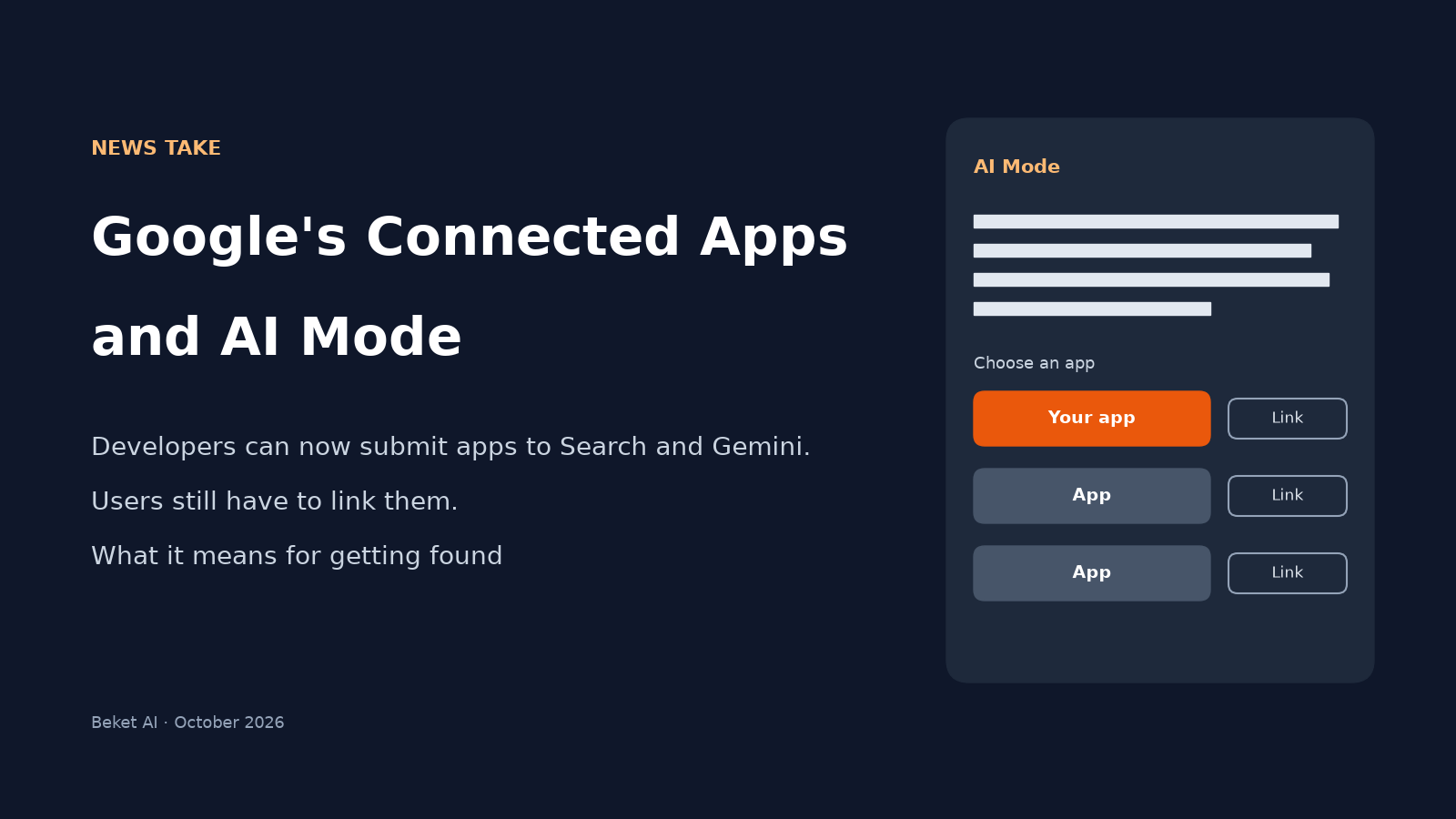
- You can name an app in your request, or make a general request and pick from a list of available apps. If the app isn't linked yet, AI Mode offers the option to link it.
- Google may default to the last app you used for a task.
So there is some discovery: a general request can surface a list of apps. But the person still has to choose your app and link an account. That favors brands people already know and use.
Google's John Mueller, quoted by Search Engine Roundtable and speaking for himself, said "it's still extremely early."
Who this matters for right now
SaaS and app companies. This is the clear group. Google's developer documentation describes connected apps as a way for users to reach "their personal live account context and complete real-world actions" from inside Google's products. If people log into your product to get a task done, this is a new place to be used. If you already run an MCP server for other AI assistants, you are part of the way there; the docs also describe OAuth 2.1 for secure user authorization.
Android app developers. AppFunctions is the on-device route. Google's Android documentation says it needs Android 16 or higher and is experimental and subject to change.
Small local businesses. Mostly not yet. A plumber or law firm usually has no app or MCP server to submit. For now, local businesses are found in AI Mode the same way as before: by being named and cited in the answer.
What brands can do today
- Decide if you have a real action to offer. Connected Apps are built around tasks done in a user's own account. A brochure site has nothing to plug in.
- If you do, join the waitlist. US developers can apply through Google's developer site. Expect a review step before anything goes live.
- Plan to measure it separately. Google says the console shows traffic, latency and errors for live apps. Treat it as its own channel; regular search reporting already has blind spots, as we covered in how to track AI Overview traffic.
- Keep your brand consistent. Google highlights verified logos and brand identity. The same name, description and logo across your site, app listings and profiles also helps AI engines recognize you as one company, which is the core idea behind entity SEO.
Why being named in AI answers still matters
Because apps are opt-in, someone first has to know your brand, then choose it, then link it. Often, that first step happens in an ordinary answer: someone asks AI Mode which tool to use for a job, and a few brands get named.
That is the same visibility question as before. Our AI Mode vs AI Overviews comparison explains how AI Mode answers differ, and the basics in how to show up in Google AI Overviews still apply. Connected Apps add a second step after being found. They don't replace the first one.
What to watch
Worth watching over the next few weeks: whether the Gemini partner apps arrive in Search as promised, how often AI Mode suggests apps for general requests, and whether Google shares more about how it chooses which apps to list.
You can see whether AI engines name your brand when people ask about your category with a free Beket AI audit: 25 prompts across 3 engines at beket.ai. Beket AI Pro is $49/month, re-audits daily and starts at 50 prompts across 3 engines.
About the author: Nur Rysbek is the CEO of Beket AI.
Related posts
Does Google AI Use Reddit as a Source? What New Data Means for Local Businesses
A 3.2M-page study finds Google AI Overviews cite user posts far more than ChatGPT or Perplexity. What our local audits show, and what to do about it.
Google Is Reportedly Hiding AI Overview Source Cards: Why Being Named in the Answer Matters More Now
Google AI Overview source cards are reportedly vanishing on desktop. Our audit of 12 local answers shows why being named in the text now matters more.
AI Mode vs AI Overviews: What's Different for Local Businesses
AI Mode vs AI Overviews: when each appears, what each cites for local searches, how they overlap, and what to do for each, with data from three studies.