
AI Mode vs AI Overviews: What's Different for Local Businesses

Type "best dentist in Seattle" into Google and you might get an AI Overview above the results, or you might not. Tap into AI Mode and ask the same thing, and you will almost always get an answer. Both features run inside Google Search and follow the same rules for which pages can appear. For a local business, though, they behave like two different engines: they show up at different times, cite different places and often name different businesses.
This post compares AI Mode vs AI Overviews side by side, using Google's own documentation and three independent studies, and ends with what to do about each one.
The differences at a glance
| AI Overviews | AI Mode | |
|---|---|---|
| Where it appears | A summary at the top of the normal results page | A separate, conversational search experience you choose to open (or reach by asking a follow-up from an AI Overview) |
| When it appears | Only when Google decides it adds something; Google says it "often" doesn't trigger | Answers whatever you ask |
| Built for | Getting "the gist" of a question quickly | Follow-up questions, reasoning and "complex comparisons" |
| Shown on "best [service] in [city]" searches | Rarely, in automated checks (see below) | Answered every one in an August 2026 study |
| What it cites for local searches | Mostly businesses' own websites (70.7% of local-intent citations) | Mostly Google Maps and Business Profile data (79.8%) |
| Brands named per answer | Fewer | 2.5x more people and brands than AI Overviews |
| Answers with no cited source | 11% | 3% |
| Who is eligible | Any page that is indexed and can show with a snippet | Same |
| Opt-out | Search Console's Search generative AI control, or nosnippet and related tags |
Same control covers both |
| Reporting | Impressions in Search Console's Generative AI performance report; clicks inside the normal Performance report | Same report, same limits |
The rest of this post unpacks the rows that matter most for a local business.
What's the same: eligibility, controls and reporting
Start with the part Google has written down, because it removes a lot of noise.
No separate entry ticket. Google's guide to AI features and your website covers both features at once. It says "there are no additional requirements to appear in AI Overviews or AI Mode," and that a page only needs to be "indexed and eligible to be shown in Google Search with a snippet." It also says you don't need "AI text files" or special schema for either one.
Both search in the background. Google says both features "may use a 'query fan-out' technique," running several related searches across subtopics and data sources before writing a response. The same guide adds that the two "may use different models and techniques, so the set of responses and links they show will vary." That last sentence explains most of what follows.
One switch controls both. The Search generative AI control in Search Console lists AI Overviews and AI Mode together. Excluding your site removes it from both, and Google warns that other sites' content "may appear similar to yours" in its place. We explain why most businesses should leave that switch alone in our post on the AI Overviews opt-out setting.
One report covers both. Search Console's Generative AI performance report counts impressions for links to your site in AI Overviews and AI Mode. Google's help page describes groupings by page, country, date and device, but not a split between the two features, and the report shows impressions rather than clicks. Our guide on how to track AI Overview traffic in Search Console and GA4 walks through what you can and can't see.
The two now connect. At I/O 2026, Google said people can "ask a follow-up question right from an AI Overview, and flow into a conversational back and forth with AI Mode," with the context carried over. So a searcher can start in one and finish in the other.
Difference 1: how often each one answers a local search
AI Overviews are selective. In Steady Demand's study of about 4,000 US local-service searches per feature (50 metros, 10 trades, August 2026), its automated collection recorded an AI Overview on 21.8% of local "best X in city" searches and 75.8% of informational ones such as "how much does a plumber cost?" AI Mode answered all 3,998 of its queries.
The authors are careful about that 21.8%, and so should we be. When they repeated 10 local searches by hand in a normal browser, a person saw an AI Overview on 5 of them, while the automated collector had seen 1. Treat it as a sign that AI Overviews show up less on local buying searches, not as a precise rate.
Beket AI's own audits saw a similar pattern. Across the six Vancouver studies in our nine-study roundup of local AI recommendations, the audits recorded a Google AI Overview for 38 of 174 logged queries (21.8%), while Perplexity answered all 174.
What this means: on the searches where a customer is choosing who to call, AI Mode is more likely than an AI Overview to be the AI answer they see, provided they open it.
Difference 2: what each one cites for local searches
This is the biggest practical gap. In the same Steady Demand study, the two features sent local-intent citations in nearly opposite directions.
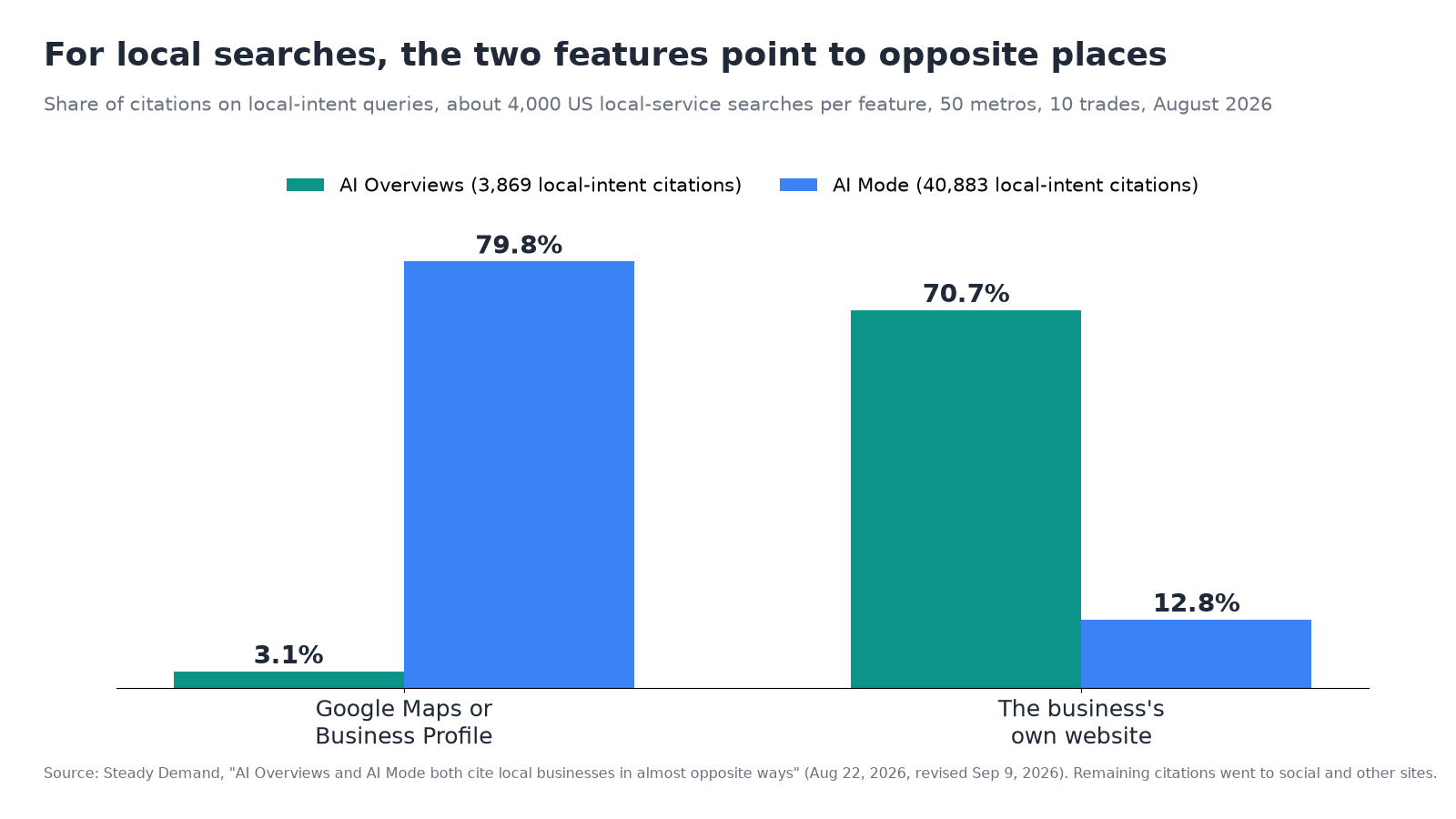
- AI Overviews pointed 70.7% of local-intent citations to the business's own website and 3.1% to Google Maps or Business Profile data.
- AI Mode pointed 79.8% to Google Maps or Business Profile data and 12.8% to the business's website.
The study flags that its "own website" category had some classification error (an estimated 11.7% of the remaining records were misclassified). The Maps and Business Profile figures were matched directly, so they don't carry that problem.
The split also changed a lot by trade. The share of AI Mode's local citations that went to Google Maps or Business Profile data ranged from 88.0% for dentists to 65.4% for house cleaning and 43.4% for personal injury lawyers. Here is part of that table:
| Trade | AI Mode local citations to Google Maps or Business Profile |
|---|---|
| Dentist | 88.0% |
| Plumber | 85.1% |
| HVAC contractor | 82.9% |
| Electrician | 76.5% |
| House cleaning | 65.4% |
| Personal injury lawyer | 43.4% |
For informational queries, AI Mode leaned on websites much more: its Maps share fell to 22.7% and business websites rose to 42.3%. So AI Mode does cite business sites, just less often when someone is choosing a provider.
The study's authors note what they did not prove: they inferred AI Mode's reliance on listing data from its links and "did not observe its selection mechanism."
Difference 3: similar answers, mostly different sources
Even outside local search, the two features rarely cite the same pages. Ahrefs compared AI Mode and AI Overview responses to the same queries in September 2025 US data (540,000 query pairs for citations, 730,000 for content).
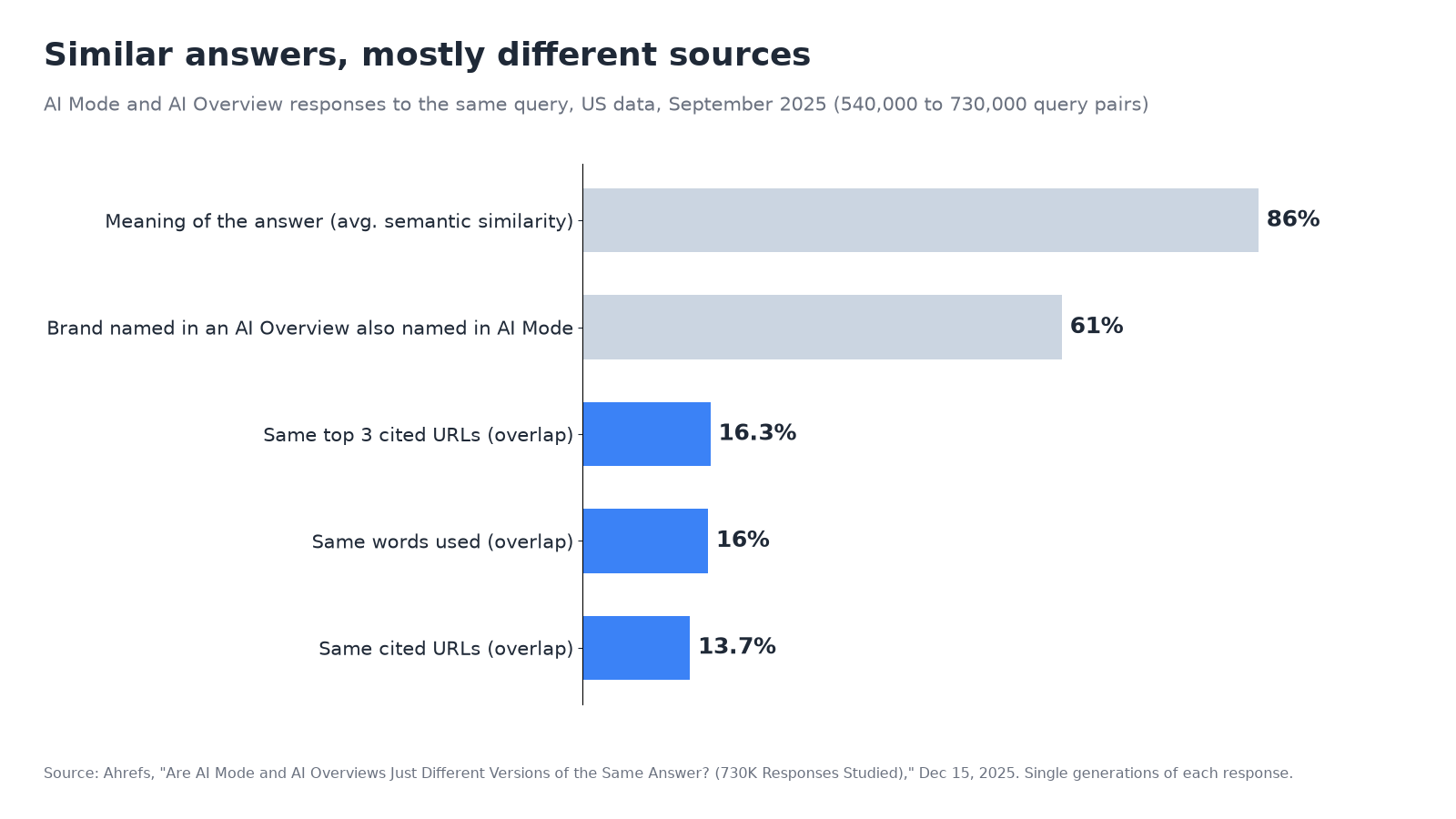
- Only 13.7% of cited URLs overlapped between the two (16.3% when comparing just the top three citations).
- Yet the answers meant much the same thing: average semantic similarity was 86%, and Ahrefs summed it up as "9 out of 10 times, AI Mode and AI Overview agreed on what to say."
- AI Mode named 2.5x more people and brands. If a brand was named in an AI Overview, there was a 61% chance it also appeared in AI Mode's longer response.
- The source mix differed: YouTube led AI Overview citations, while AI Mode cited Quora 3.5x more often and Facebook about twice as often.
Ahrefs adds an important caveat: it compared single generations of each answer, and its earlier research found 45% of AI Overview citations change between generations. The two features may draw from a wider shared pool than one snapshot shows.
The takeaway for a business is simple: being cited in one does not tell you much about the other. Check both.
Difference 4: AI Mode is not the map pack, either
If AI Mode leans on Google Maps data, you might assume it just repeats the local pack (the three map results). It doesn't. A Local SEO Data study ran 1,120 local searches across 7 trades and 13 US cities, including Seattle, in May 2026:
- 71.5% of local pack businesses also appeared in AI Mode for the same search, so 28.5% didn't.
- Comparing only the top three from each, overlap fell to 48%.
- AI Mode showed a median of 5 businesses per search, against the local pack's fixed 3.
- Wording mattered. A bare "divorce lawyer" returned no business cards in any of the 10 cities tested; adding "near me" returned them in all 10. Adding "best" to "criminal defense lawyer" removed business cards in all 10 cities and produced educational content instead.
- Reviews tracked differently by trade. Plumbers shown only in AI Mode had a median of 546 reviews versus 125 for those shown only in the local pack, but for lawyers and medical specialists the pattern reversed.
The study is clear that these are correlations from a three-day snapshot, collected through an API without personal location signals. Still, it lines up with the citation data: AI Mode's local answers start from Google's business listings but don't simply copy the rankings.
What to do for each one
Because both features share eligibility rules, the foundation is the same. The emphasis differs.
| If you want to show up in... | Put more weight on | Why |
|---|---|---|
| AI Overviews | Website pages that directly answer the questions customers ask before they choose (prices, how long a job takes, what's included) | AI Overviews appeared far more often on informational searches and mostly cited business websites for local intent |
| AI Mode | Your Google Business Profile: correct primary category, services, service area, hours, photos, and a steady flow of genuine reviews | Most of AI Mode's local citations pointed to Maps and Business Profile data |
| AI Mode, for lawyers and other professional services | Practice-area and educational pages, plus listings on respected directories in your field | AI Mode cited Maps data far less for personal injury lawyers and often showed educational content for some legal searches |
| Both | Indexable pages with no stray nosnippet tags, Googlebot allowed in robots.txt and your CDN, structured data that matches the visible page, and mentions on the third-party sites each feature cites |
Google's rules for both features are the same, and the two features cite different outside sources |
Two cautions. First, none of these studies show that a change causes a citation. They compare what got cited, and Steady Demand says its review and profile findings can't tell whether those helped a business get cited in the first place. Second, every number above is a snapshot. Both features change answers from one run to the next.
For the step-by-step version of the AI Overviews column, see how to show up in Google AI Overviews.
How to check where you stand
- Search like a customer, in both places. Take 10 to 20 searches that bring you business, such as "best [service] in [city]," "[service] near me" and a price question. Run each one on the normal results page and in AI Mode, and note who is named and which sources are cited.
- Try different wordings. The Local SEO Data results show that "near me," a city name or "best" can change whether business cards appear at all.
- Open the Generative AI performance report in Search Console to see which of your pages get impressions from AI features, keeping in mind that it doesn't separate AI Overviews from AI Mode.
- Repeat it. One check is one draw. Re-run the same list every few weeks.
Google isn't the only AI your customers use. A free Beket AI audit runs 25 prompts across 3 AI engines and shows which businesses each one names and whether yours is among them. Beket AI Pro is $49/month, starts at 50 prompts across 3 engines and re-audits daily, so you can see whether changes like the ones above move the answers over time.
Related posts
Which Seattle Realtors Does AI Recommend? 2026 Study
Windermere led 277 AI mentions of Seattle realtors on October 27, 2026. See who ChatGPT, Perplexity and Google AI Overview named, and how.
Does Google AI Use Reddit as a Source? What New Data Means for Local Businesses
A 3.2M-page study finds Google AI Overviews cite user posts far more than ChatGPT or Perplexity. What our local audits show, and what to do about it.
Which Seattle Mortgage Brokers Does AI Name? 2026 Study
Blue Square Mortgage led 311 AI mentions of Seattle mortgage brokers on October 27, 2026. See who ChatGPT, Perplexity and Google AI Overview named, and how.